
Our Work
In Bangladesh
Bangladesh is one of the most densely populated countries in the world. While it has made huge strides in reducing poverty over the past three decades, around 20 per cent of the country still live below the poverty line.
Full Name: People's Republic of Bangladesh
Population: 169,626,554
Capital: Dhaka
Area: 148,460 km²
Major Languages: Bengali
Major Religions: Muslim
A low-lying country with rich agricultural heritage, Bangladesh is exceptionally vulnerable to the impacts of climate change and natural disasters such as floods and cyclones. It is also at a high risk of earthquakes.
Through United Purpose, we have been working in Bangladesh for more than 25 years. Focused on community-designed and led programming, we’re committed to building close partnerships with local stakeholders and leaders to enable people to have control over their own lives.
Across Bangladesh, we work primarily through grassroots enterprise hubs known as youth or women’s business centres. These networks of women-led centres enable a unique, enterprise-based programming approach. The aim is to address some of the greatest challenges to sustainable development. In humanitarian and emergency situations where enterprise is not possible, we work to similar approaches to position our community partners as drivers of change.
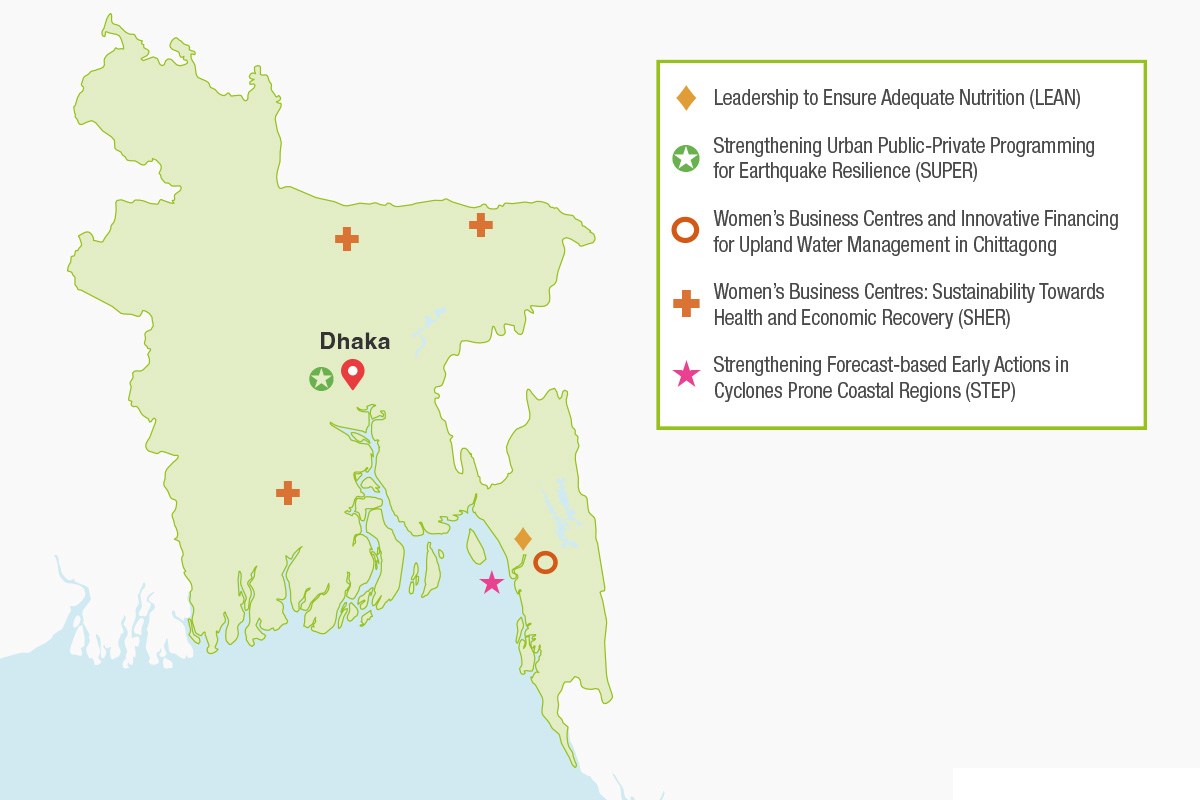
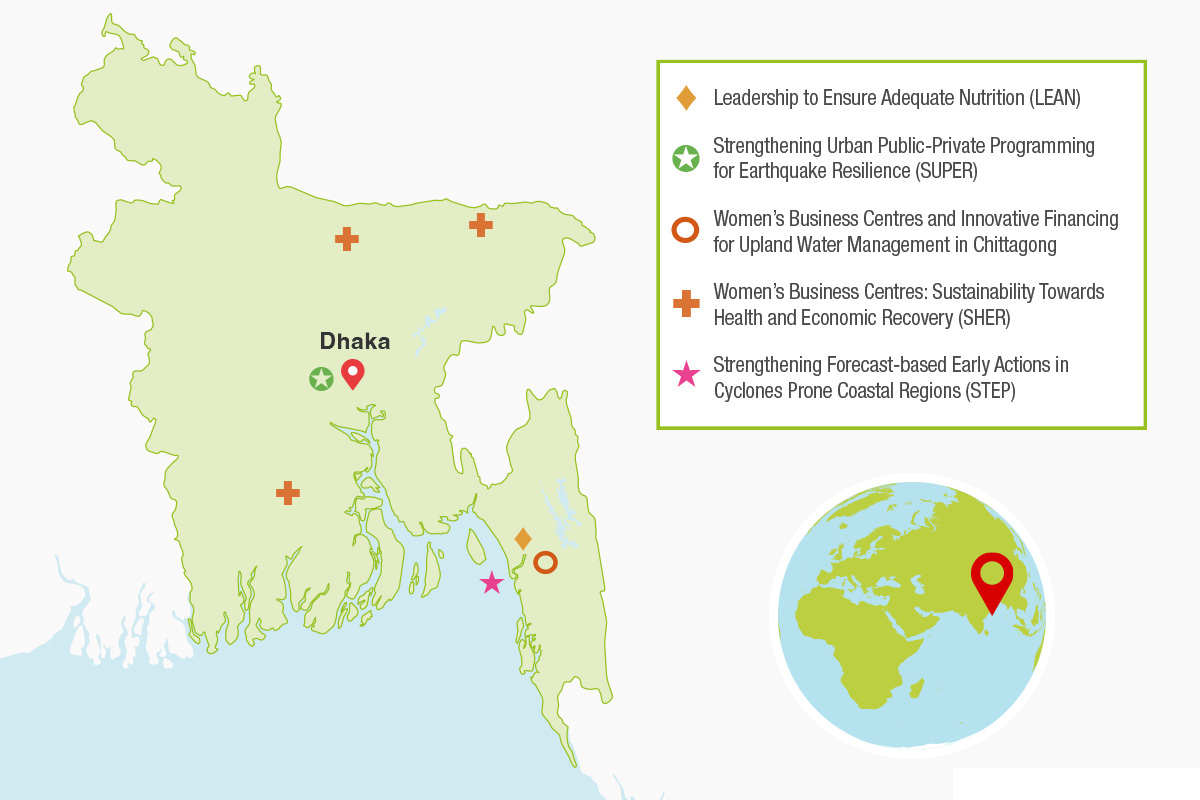
Bangladesh projects
Leadership to Ensure Adequate Nutrition (LEAN)
In recent years, Bangladesh has made significant progress in improving people’s access to enough nutritious food. However, undernutrition remains high. Stunting is particularly high in the three Chittagong Hill Tracts districts. Inadequate infrastructure, insufficient clean water supply and the remote locations of the communities all restrict access to nutrition and health services.
During our five-year, ‘Leadership to Ensure Adequate Nutrition (LEAN) project in the Chittagong Hill Tracts, we aim to improve maternal and child nutrition in three core areas:
- Improved nutrition governance
- Increased community-led nutrition awareness
- Strengthened local value chains
With this in mind, we are training local leaders through the Women’s Business Centres to disseminate relevant nutrition information, which is supported by more than 4,000 youth and student groups.
LEAN is funded by the European Commission and implemented in a consortium with Helvetas Swiss Intercooperation Bangladesh, The Global Alliance for Improved Nutrition (GAIN), Caritas Bangladesh, Jum Foundation and Integrated Development Foundation.
Building on the success of Women’s Business Centres
Our Women’s Business Centres (WBCs) prioritise local knowledge and close partnership with community stakeholders and leaders to enable people to express agency over their lives, so they can move beyond aid. Through the 400+ WBC enterprise hubs, we work directly with more that 2,000 women entrepreneurs across the country who each day serve a population of more than 2.5 million in some of the most climate vulnerable and under resources areas of the country.
We’ve created the Nari Jhuri ‘Women’s Basket’ Social Enterprise Network. It provides women entrepreneurs with access to new forms of capital - including impact investment, revenue from product sales and service delivery – and harnesses the collective purchasing power of thousands of business women.
Sustainability towards Health and Economic Recovery (SHER)
Our Women’s Business Centre (WBC) network, established with Coca-Cola’s support, is a robust, viable model long-term community development and has successfully organised enterprising women into cooperative business structures. The initial project equipped around 100,000 women with the means to gain control of their lives. Now we’re building on that success.
In the sixth phase of Coca-Cola’s support of our WBC model, our Sustainability towards Health and Economic Recovery (SHER) project aims to reach an additional 40,000 women producers in Jamalpur, Sunamganj, and Gopalganj districts. It will particularly focus on aligning with Government public health and mental health awareness programming, while equipping WBCs with new digital tools that expand their service delivery offering.
Women business centres and innovative financing for upland water management in Chittagong Hill Tracts
We are also working with seven WBCs in the Chittagong Hill Tracts to improve remote, low-income communities’ access to sustainable safe water. With local government supervision and oversight, we’re constructing or rehabilitating seven public water supply schemes for 5,000 people and taking a market-based approach to provide another 5,000 people with access to domestic water filters. The WBCs will manage the schemes, using a community-based enterprise model. The aim is to demonstrate appropriate service delivery models that can be replicated in other communities. Learn more by visiting www.womensbusinesscentres.org
Disaster risk reduction and management
Bangladesh has a long history of natural disasters. When disasters occur, the poorest communities are always hit hardest.
Strengthening Urban Public-Private Programming for Earthquake Resilience (SUPER) Project
To support earthquake preparedness efforts, and increase national disaster management capacity and coordination, we are in partnership with ActionAid Bangladesh and with funding from ECHO, to implement the ‘SUPER’ project. The project is strengthening earthquake disaster risk management for urban communities by building capacity in the private sector and facilitating cooperation with the public sector.
‘Strengthening Forecast-based Early Actions in Cyclone Prone Coastal Regions in Bangladesh’ (STEP) Project
In southern and southwestern cyclone-prone coastal regions, we are working with local disaster management committees, community-based organisations, the authorities and communities to ensure early action is taken, disaster forecasting is better and these efforts are linked to existing social protection systems.
The STEP Project is an ECHO-funded partnership between Self Help Bangladesh, Action Contre la Faim (ACF), Plan International Bangladesh (PIB) and Cordaid.
The project is being implemented in four southern cyclone prone districts – Bagerhat, Barguna, Satkhira and Patuakhali.
STEP aims to strengthen the resilience of institutions and cyclone vulnerable communities by introducing forecast-based early action or anticipatory action in local disaster response management governance. The project supports the implementation of risk reduction actions that help better protect communities from the devastating impact of a cyclone, as part of a wider disaster preparedness plan.
The STEP project also supports national and local authorities in improving institutional, legislative and policy frameworks that are specific to preparedness and response where appropriate, relevant and necessary, in collaboration with partners. . The project aims to enable coordination and collaboration between the Ministry of Disaster Management and Relief, the national forecast-based financing/action taskforce, implementing agencies, communities and the local authorities.
Strengthening social cohesion and civil society capacity within Cox’s Bazar (SSC)
The large number of Rohingya refugees migrating to and living within Cox’s Bazar have affected social cohesion, livelihoods and the local social and economic landscape. Our SSC project addresses these challenges by identifying livelihood opportunities for communities and supporting people to develop the skills they need to create and improve small-, and medium-sized enterprises in response. The project also supports local non-governmental organisations to better address these needs, promoting bottom-up responses to humanitarian crisis in the area.
TO CONTACT US ABOUT OUR WORK IN Bangladesh:
House 26 (3rd and 4th floor), R#28, Block K,
Banani, Dhaka 1213, Bangladesh
T: +88 02 9855296
Cell: +88 01819-263295
Email: [email protected]