
Up to 50% of Ethiopia’s farmland is degraded. Conference looks at remedies that can support small-scale farming households.
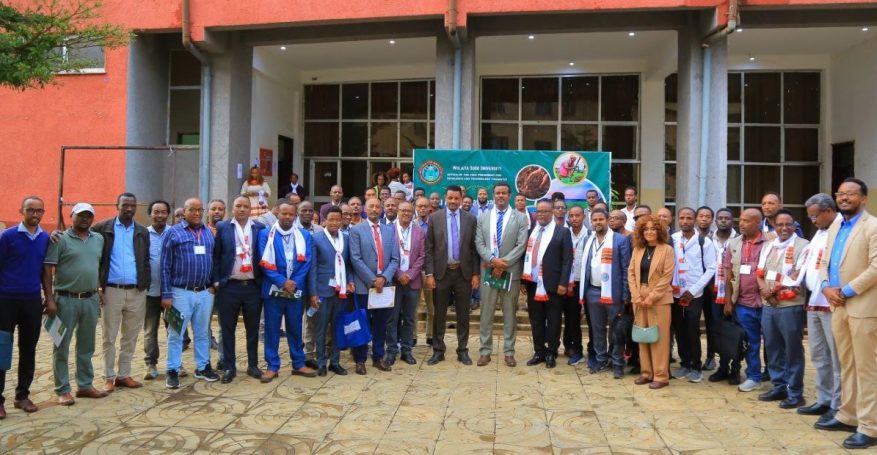
Practical methods of enhancing soil fertility on small-farms in Ethiopia was the focus of an annual research conference that brought together more than 200 academics, government agencies, development organisations and research institutions, in the country.
Organised and co-sponsored by Self Help Africa, the 14th annual research conference at the Wolaita Sodo University heard presentations on a range of themes around soil fertility management and soil and water conservation. The event showcased innovative solutions – including how artificial intelligence (AI) can be used to support soil advisory systems, to natural measures such as the application of carbon-rich biochar and the benefits of bamboo planting to land restoration.
Delegates heard an opening address from the Vice-President for Research at Wolaita Sodo, Associate Professor Zewedu Teshome, who spoke about the need for collaborative engagement across sectors. He said agricultural transformation should be measured “in grain silos, in the restoration of degraded landscapes and felt in the pockets of farmers.”
The Head of Programmes at Self Help Africa, Theodros Eshetu spoke about the organisation’s 40-years history in Ethiopia, and some of the practical activities that Self Help Africa had carried out to improve soil health and productivity on small-holder farms.
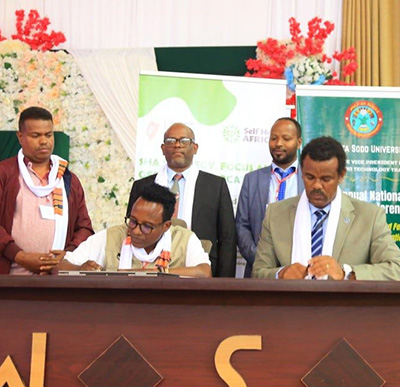
Theodros Estetu signed a memorandum of understanding (MOU) with Wolaita Sodo University at the conference. He said that the agreement would strengthen the partnership with Self Help Africa, and link research outputs with practical interventions, while also seeking to influence the policy environment to benefit smallholder agriculture.
Self Help Africa exhibited materials at the conference that spotlighted the organisation’s work in soil management, including the use of vermicomposting, biochar, keyhole gardening and fertiliser management.
Upwards of 50% of Ethiopia’s 100 million hectares of farmland is estimated to be degraded, with surveys showing that more than two million hectares are unusable, as a result. Soil erosion that strips top soil, nutrients and organic matter from farmland can halve farm productivity.