
Rob MacGoey, Chair, Boston Advisory Board, Self Help Africa
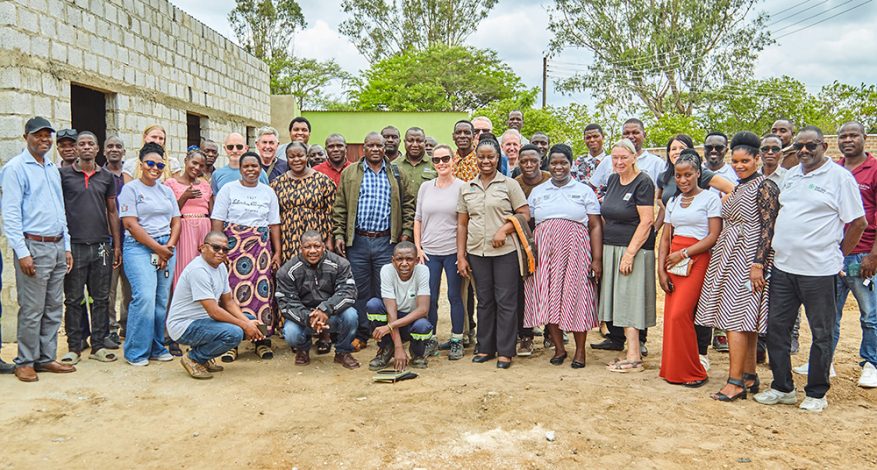
I had the opportunity to visit projects in Zambia late last year. The trip gave me a deeper appreciation for both the challenges faced by local communities, and of the remarkable impact of this work.
Zambia is a vast country with a population of about 22 million people. It’s slightly bigger than Texas, with roughly two-thirds the population. Between 50–60% of people live in extreme poverty, meaning less than $2.15 per day. Poverty in rural areas, where 70% of people rely on farming, can be as high as 80%. Approximately half the population is under 18.
In 2024, the government introduced free education. This is a positive change, providing new opportunities for future generations. However, schools have very limited resources. In addition, poverty impacts school attendance and performance in many ways; for example, malnutrition in children, girls who do not have access to sanitary products, and sickness and disease from poor sanitation.
Tackling issues of environment, resources, knowledge, and tradition at any scale that is impactful is very complex. On this visit, we learned that such change involves finding willing participants, engaging communities, understanding the complete value chain, educating people, implementing new practices and new technologies, organizing individuals into groups who can source and sell goods at better prices and, very importantly, creating the knowledge, access to resources, and confidence that inspires people to continue to innovate and expand beyond any initial help provided by SHA. In addition, it requires close collaboration with many other organizations, such as tribal, local, and national government bodies and other NGOs.
SELF HELP AFRICA’S WORK
We travelled to Zambia’s Southern Province, and visited two projects that are underway in the area:
- Preserve Kafue Project and Developing Sustainable Systems in Drought and
- Affected and Food Insecure Districts (DROPP).
The projects in aggregate target 7,500 families – about 45,000 beneficiaries. Working with government and tribal leaders, Self Help Africa identifies high-risk families that are often women-led households where only one working adult can be supporting 5–6 children. The focus of both projects is on building resilience, increasing food and income, improving nutrition, and providing clean water. On the visit we observed how:
- Access to water is a challenge, and the value of Self Help Africa’s work, training farmers on effective irrigation, water storage and how to sustainably finance water supplies.
- SHA introduces new crops that yield more production, are more drought resistant, promote crop diversity, and provide wider nutritional content for families.
- SHA educates households on the importance of soil quality, including the importance of trees in the ecosystem and financing tree planting.
- SHA helps in sourcing quality seeds and planting materials, and supports farmers to themselves become seed producers.
This creates a supply of quality seed at a local level and provides another source of income for the seed-supplying farmers. Through organizing farmers into groups, the commercial seed suppliers have also become buyers of the farmers’ seed supply.
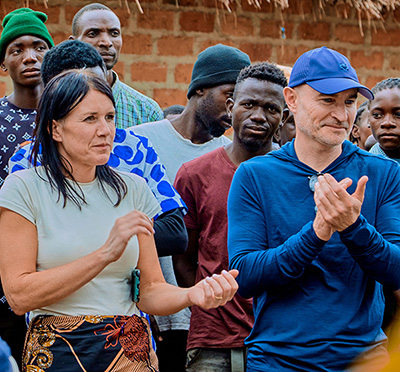
SHA teaches farmers to dry produce in a manner that maintains the nutrient content. This allows farmers to preserve food and use crops to produce different end products, like dried snacks that are nutritionally dense for kids to bring to school.
We met with representatives of Cassia Produce, an agro-enterprise that is benefitting from SHA’s assistance with storage and production. Cassia collects and aggregates the produce of the farmers, provides storage facilities for safe storage of seeds, and provides processing and packaging of dried goods.
Cassia is working to get various products approved by the Zambian food authorities so they can be sold to retailers, which will improve the prices at which goods can be sold. SHA has also created a model that supports and governs the establishment of Village Savings and Loan groups. We met with a community of households that save a minimum predetermined amount each month, which allows families to build some financial security and allows access to loans from the funds for growth or emergency needs. In all these endeavors, it is not a single household operating in a silo. There are multiple households working together, supporting and motivating each other to increase productivity and income. The households we met were always interested in speaking with us about what they’re doing next – establishing beehives, planning for bigger pumps to irrigate a larger area of land, creating fishponds to improve protein in diets… the list goes on.
What is also remarkable is the collateral impact this positive energy has on innovation to address other community issues. For example, Cassia procured sewing equipment, and young men and women in communities in the Southern District are being taught to make reusable sanitary pads that are economically and environmentally friendly and help address the issue of school absence.
Involving the youth provides a source of income for them, which they otherwise have limited access to. Cassia is seeking approval for these products for wider sales and distribution. We met with a group of young men and women using small wood cuttings to create biofuel that is smokeless (addressing common respiratory issues where charcoal or wood is burned indoors) and provides an excellent source of natural fertilizer for crops. The initiative is in concert with the forestry authority. Youth are taught how to prune and protect trees, highlighting the importance of trees to soil quality. This creates yet another source of income for people.
REFLECTIONS
Self Help Africa’s mission is to support sustainable livelihoods for Africa’s smallholder farmers and rural communities to alleviate hunger, poverty, and social inequality. Last year, Self Help Africa implemented close to 100 projects. Despite being involved for many years, it is difficult to truly understand, or convey to others in an effective manner, the impact of SHA’s work. Having visited Zambia, I have a better appreciation for both the work and the impact it’s having (recognizing there is much more being done that we did not observe).
Most of us are not farmers, and so it is not immediately obvious how intricate the process is and how many variables exist. The process involves land preparation, seed selection, sowing, fertilization, irrigation, pest control, harvesting, storage, and marketing. The variables include soil quality, weather, water levels, pests, and market pricing.
In addition, close relationships with government agencies, tribal, and NGO leaders must be forged in order to operate effectively within these communities and to partner wisely with existing resources to have maximum impact.
The level of engagement, planning, effort, and the granularity of the work is remarkable. While the entire body of work is complex, the solutions at the process level must be practical, scalable, meaningful, and take root quickly to get buy-in from the participants and motivate them and others in the community to continue to improve.
What we witnessed were lives changing. We heard firsthand about improving health from better nutrition and sanitation. We saw the ambition that follows success and the drive to continue to improve standards of living. We heard hope from the youth that things can get better as more opportunities present themselves. We also saw the joy that people experience when they come together to generate success. Despite poverty, despite the conditions, despite the slog, despite inequity, despite the odds, these communities went about their daily lives with joy and purpose.
The one constant was the need for resources. The projects we observed will touch 45,000 people in Zambia. Among the households we visited, there was much more that could be done beyond the scope of the projects; for example, many did not have a latrine.
There are many other issues that can be addressed, and there are many people who are not impacted by projects, in Zambia and across Africa’s population of 1.5 billion people. Climate change is making the situation even more precarious.
Stepping back from it all, I am very proud to be involved with this work, honored to have had the experiences I did, and was inspired to do more. I am also very aware that much more has to be done, although I won’t pretend to truly comprehend the scale of that challenge. Therefore, it is difficult not to be overwhelmed by the size of the problem and the number of variables working against us.
However, I believe it is our responsibility to do what we can to help lift people out of poverty. I have now seen first hand that we do this, and therefore, we should continue to do so. The helplessness of not being able to fix it all is important to recognize, maybe even honor, but it’s equally important not to let it stand in the way of what can be done.
Finally, the focus of most of the above was the work and the beneficiaries of that work. It is important to understand the actions being taken and the successes we are having to help people in need. But the other part of this trip was seeing the people who are doing the work.
They are smart, committed, driven, and proud people who we observed as personally vested, realistic, and yet optimistic and very effective. I was proud of the talent that SHA attracts; it speaks volumes about the organization and the work being done.